ATLAS: Discovering Agent Strategies through LLM-Guided Abstraction and Automata Learning
Abstract
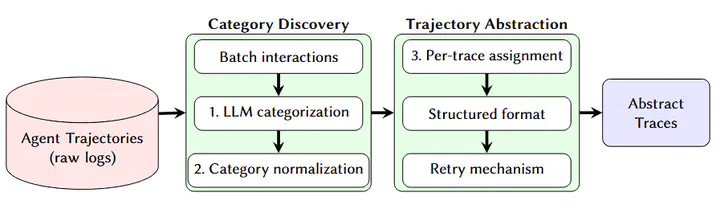
Large Language Model (LLM)-based agents are increasingly used for complex tasks such as software testing and cybersecurity assessment. While these agents demonstrate impressive capabilities, their behavior is difficult to understand, explain, and analyze. Existing evaluations focus mainly on task success and execution traces, offering limited insight into the strategies employed by the agent. We present ATLAS (Automata Learning for Agent Trajectory Analysis and Strategy Discovery), an approach for recovering interpretable behavioral models from agent trajectories. ATLAS combines trace abstraction with automata learning to infer finite-state models that capture observed agent-environment interaction strategies. These models provide human-interpretable insights and support automated analyses of recurring behaviors, decision points, successful task-completion paths, and failure loops. As a proof of concept, we apply ATLAS to trajectories generated by an LLM-based penetration-testing agent. The resulting models expose high-level behavioral strategies for exploiting vulnerable machines that are difficult to identify from raw execution traces alone. We discuss how learned behavioral models can support explainability, model-guided exploration, auditing, and analysis of agentic systems. We further demonstrate symbolic model-based knowledge transfer from powerful frontier models to compact language models. In addition, we show how model transformations can derive concise explanations of agent behavior in a penetration-testing case study comprising 12 vulnerable machines. ATLAS highlights a new opportunity for model-driven engineering: transforming agent trajectories into explicit behavioral models that enable systematic understanding and analysis of otherwise opaque AI agents.

Ignacio D. Lopez-Miguel
PhD student
I am a PhD student at the Technical University of Vienna (TU Wien)